
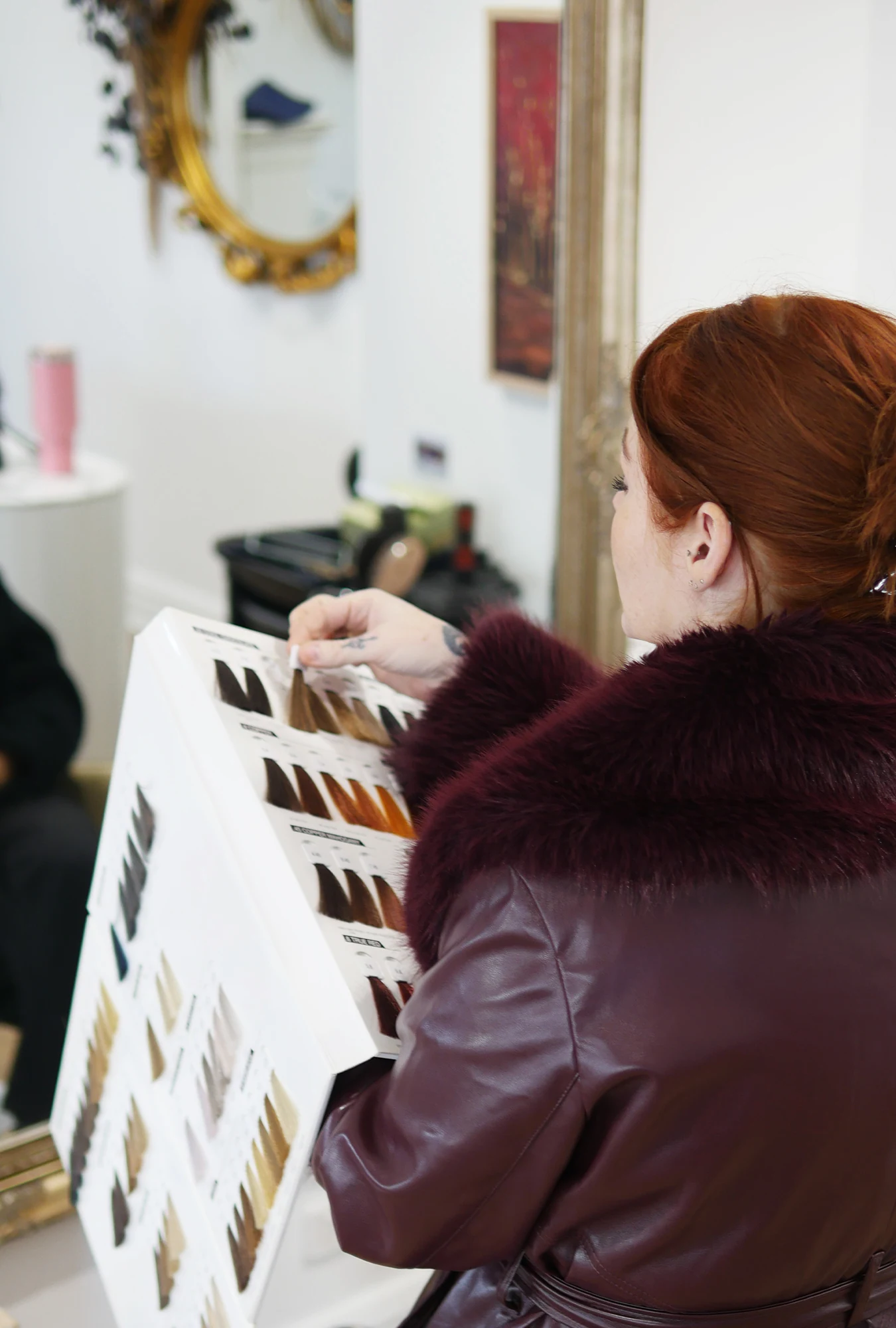
The honest starting point: we are not colouring a blank canvas.
A straightforward colour service begins with a relatively predictable base. A correction begins with a history. There may be permanent colour through the ends, old lightener underneath it, darker bands, areas that have faded faster, an over-toned blonde, unexpected warmth, direct dye or a result that simply does not sit evenly from roots to ends.
Putting a new shade over that history does not make the history disappear. In some areas it may deepen the problem; in others it may grab too dark, turn muddy or expose more warmth. Jamie-Lee first has to work out what is present, where it changes and what the hair can reasonably tolerate before deciding what should be removed, rebuilt or left alone.
The fastest route to the inspiration photograph is not always the safest route from the hair you have today. A good correction starts by separating the desired destination from what can be achieved responsibly in one appointment.
A long appointment is a sequence of separate jobs.
The consultation and any recommended strand testing happen before the larger booking because they determine whether the intended pathway is realistic. On the correction day, the work may include several of the following steps:
- Map the colour history and divide the hair into zones that need different treatment.
- Remove or soften unwanted artificial pigment only where it needs to move.
- Lighten selected areas while monitoring how quickly each section responds.
- Rinse, cleanse and dry enough of the hair to see the new starting point accurately.
- Replace missing underlying pigment before moving darker or changing direction.
- Apply separate root, mid-length and end formulas when one formula would not be even.
- Tone, condition, refine, dry and check the result in different light.
Every chemical stage includes application time, processing time and removal. Many stages cannot simply be stacked on top of one another because the result of one step determines the formula for the next. That is why a serious correction can occupy most of a working day even when the finished colour looks effortless.
If the hair responds differently from the strand test or reveals another layer of colour history, the plan may need to slow down or change. That is not wasted time. It is the point at which professional judgement prevents a difficult starting point from becoming a more difficult one.
One head of hair can require several formulas.
Roots, mid-lengths and ends often have different colour histories and different levels of porosity. A formula that is right for one zone may be too strong, too cool, too warm or too deep for another. Correcting visible bands can mean mixing and applying several formulas in a deliberate order rather than covering the whole head with one bowl.
Length and density matter too. More hair requires more product, but it also requires more sectioning, saturation and checking. Precise application is slow for a reason: uneven saturation can recreate the very banding the appointment is intended to remove.
This is also why an online photograph cannot produce a reliable fixed quote by itself. Two clients asking for the same colour may need completely different chemistry, quantities and appointment time because their starting points are not the same.
What the price actually covers.
Colour correction at Muse & Moonlight starts from $450. That is a starting point, not a promise that every correction fits the same price. The final plan reflects the chair time, technical complexity, product required, length, density and number of stages involved.
A substantial appointment block
Complex corrective work may reserve most of Jamie-Lee's working day so the process is not rushed between other clients.
Time to assess and refineExperience in every decision
The service includes diagnosis, formulation, placement, monitoring and the judgement to change course when the hair reveals something new.
More than one bowl of colourEnough product for even work
Longer, denser hair and multiple colour zones require more formula, careful saturation and often several rounds of application.
Planned for your starting pointThe price is therefore not the cost of a tube of colour. It is the cost of the complete service and the time required to perform it responsibly. The consultation gives Jamie-Lee the best opportunity to explain the likely range, what can reasonably happen in one day and what could change the scope.
Staging the correction can be the most client-centred option.
Some corrections can be completed in one appointment. Others are better approached over two or more visits. Staging is recommended when pushing further in one day would ask too much of the hair, when an old pigment needs to be moved gradually or when the final target is several steps away from the current colour.
A staged plan may cost more overall than a simple one-day service, and Jamie-Lee will be direct about that. Its value is that each visit has a realistic goal, the hair can be reassessed between stages and you can leave with a wearable result while moving toward the longer-term destination. It may also reduce the likelihood of paying to correct a rushed correction later.
The long-term benefit is choice. Preserving as much condition and length as reasonably possible leaves more options for future colour, styling and extensions. Rushing toward a dramatic result can narrow those options very quickly.
Aftercare still matters, but it is a supporting part of the correction rather than the reason for it. Jamie-Lee will explain the few habits and products that matter for your hair without turning the appointment into a shopping list. More practical guidance is available in the hair care guide.
Before we quote
Bring the truth of the hair, not only the inspiration photo.
- Bring photographs of the current colour in natural light and examples of the desired direction.
- Share the full colour history of the hair that is still on your head, including professional and at-home colour.
- Mention direct dye, henna, lightener, smoothing services and any previous corrective work.
- Explain any recent breakage, unusual dryness or areas that feel different from the rest.
- Share deadlines, maintenance preferences and the investment range you are comfortable discussing.
- Be open to strand testing or a staged result when the starting point calls for it.
The unfiltered answer: colour correction costs more and takes longer because each major decision depends on what the previous step reveals. If the work could be completed safely and beautifully in two hours, Jamie-Lee would not stretch it to six. The extra time is there to understand the hair, work section by section and avoid creating another problem that needs correcting.